Jim Harris

My name is Jim Harris, I am the Blogger-in-Chief of OCDQ Blog, and an independent consultant, speaker, and freelance writer for hire.

My Services Contact Me
Search OCDQ Blog
Recent Comments
« DQ-BE: Dear Valued Customer | Main | DQ-View: The Poor Data Quality Blizzard »
Thursday
Feb032011

The People Platform

Platforms are popular in enterprise data management.  Most of the time, the term is used to describe a technology platform, an integrated suite of tools that enables the organization to manage its data in support of its business processes.

Other times the term is used to describe a methodology platform, an integrated set of best practices that enables the organization to manage its data as a corporate asset in order to achieve superior business performance.

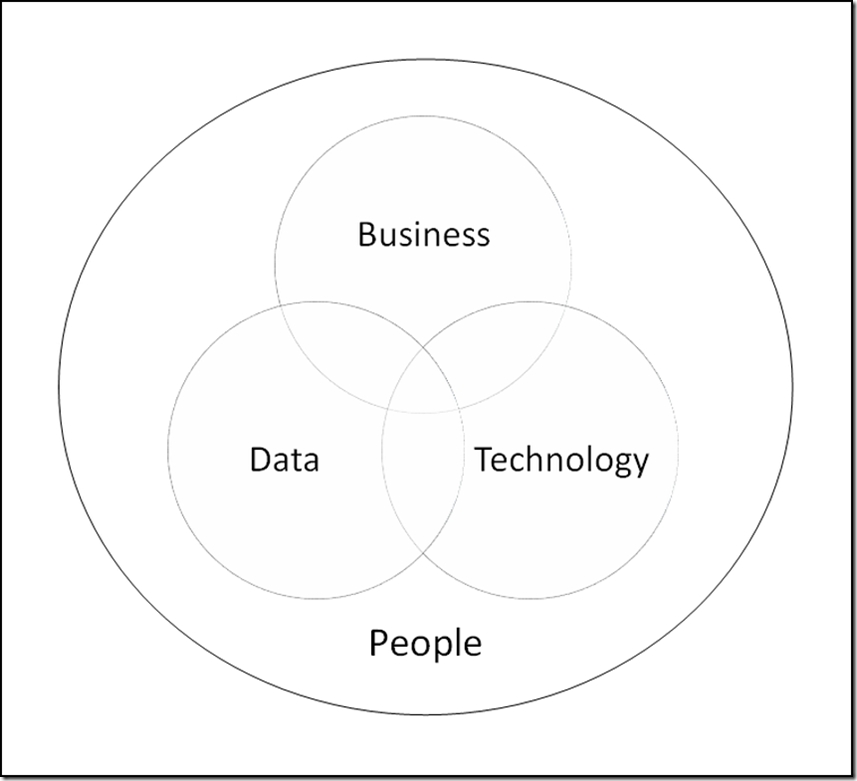
Data governance is an example of a methodology platform, where one of its central concepts is the definition, implementation, and enforcement of policies, which govern the interactions between business processes, data, technology, and people.

But many rightfully lament the misleading term “data governance” because it appears to put the emphasis on data, arguing that since business needs come first in every organization, data governance should be formalized as a business process, and therefore mature organizations should view data governance as business process management.

However, successful enterprise data management is about much more than data, business processes, or enabling technology.

Business process management, data quality management, and technology management are all people-driven activities because people empowered by high quality data, enabled by technology, optimize business processes for superior business performance.

Data governance policies illustrate the intersection of business, data, and technical knowledge, which is spread throughout the enterprise, transcending any artificial boundaries imposed by an organizational chart, where different departments or different business functions appear as if they were independent of the rest of the organization.

Data governance policies reveal how truly interconnected and interdependent the organization is, and how everything that happens within the organization happens as a result of the interactions occurring among its people.

Michael Fauscette defines people-centricity as “our current social and business progression past the industrial society’s focus on business, technology, and process.  Not that business or technology or process go away, but instead they become supporting structures that facilitate new ways of collaborating and interacting with customers, suppliers, partners, and employees.”

In short, Fauscette believes people are becoming the new enterprise platform—and not just for data management.

I agree, but I would argue that people have always been—and always will be—the only successful enterprise platform.


Related Posts

The Collaborative Culture of Data Governance

Data Governance and the Social Enterprise

Connect Four and Data Governance

What Data Quality Technology Wants

Data and Process Transparency

The Business versus IT—Tear down this wall!

Collaboration isn’t Brain Surgery

Trust is not a checklist

Quality and Governance are Beyond the Data

Data Transcendentalism

Podcast: Data Governance is Mission Possible

Video: Declaration of Data Governance

PrintView Printer Friendly Version

EmailEmail Article to Friend

Reader Comments (4)

Great post Jim.

It always strikes me as bizarre how organizations cite their need for greater "customer-centricity" but then build information services for them that are clearly oriented towards internal IT and processes.

Companies that continue to focus on the role of the individual, no matter where they are in the fabric of the business, can claim a real differentiator even if they're offering basic services or products.

I think we're still seeing the dawn of data governance, we're a long way from some kind of universal agreement, a nagging doubt is that we're coining the wrong term completely.

February 3, 2011 | Unregistered CommenterDylan Jones

From the LinkedIn Group for Enterprise Data Quality, Gordon Hamilton commented:

“Now if we could just get that people platform versioning to work a little easier. :)

In all seriousness Jim, I totally agree. If we aren't mindful of the people platform, we might even be naive enough to facilitate a shift to data governance through just tools and architecture; forgetting that the data of the people platform is managed by the people, for the people.”

And I responded:

Thanks for your comment, Gordon.

People platform versioning makes me think of the human-form cylons from the Caprica/Battlestar Galactica TV series :-)

And to extend your excellent Abraham Lincoln analogy, perhaps we need to evangelize that data governance must be of the people, by the people, for the people.

Best Regards,

Jim

February 3, 2011 | Registered CommenterJim Harris

From the LinkedIn Group for the Master Data Management Interest Group, Mark Allen commented:

“Nice posting, Jim. I definitely agree and think you are burrowing into the real core of what makes or breaks EDM and MDM type initiatives -- it's the people.

Business models, processes, data, and technology all provide fixed forms of enablement or constraint. And where in the past these dynamics have been very compartmentalized throughout a company's business model and systems architecture, with EDM and MDM involving more integrated functions and shared data, people become more of the x-factor in the equation. This demands the presence of data governance to be the facilitating process that drives the collaborative, cross-functional, and decision making dynamics needed for successful EDM and MDM.

Of course, the dilemma is that in a governance model people can still make bad decisions that inhibit people from working effectively. So in terms of the people platform and data governance, there needs to be the correct focus on what are the right roles and good decisions made that can enable people to interact effectively.”

And I responded:

Thanks for your great comment, Mark.

Excellent point about how "people can still make bad decisions that inhibit people from working effectively" and therefore we must be diligent about clearly defining and communicating the right roles and responsibilities so that we can ensure people accept accountability for making good decisions and enabling effective enterprise-wide interactions.

Best Regards,

Jim

February 4, 2011 | Registered CommenterJim Harris

Check out the great comments that this blog post received from its syndication on Information Management:

The People Platform on Information Management

May 29, 2011 | Registered CommenterJim Harris

PostPost a New Comment

Enter your information below to add a new comment.

My response is on my own website »
Author Email (optional):
Author URL (optional):
Post:
 
Some HTML allowed: <a href="" title=""> <abbr title=""> <acronym title=""> <b> <blockquote cite=""> <code> <em> <i> <strike> <strong>