Jim Harris

My name is Jim Harris, I am the Blogger-in-Chief of OCDQ Blog, and an independent consultant, speaker, and freelance writer for hire.

My Services Contact Me
Search OCDQ Blog
Recent Comments
« DQ-Tip: “There is no such thing as data accuracy...” | Main | DQ View: Achieving Data Quality Happiness »
Thursday
Sep162010

The Business versus IT—Tear down this wall!

Business Information Technology

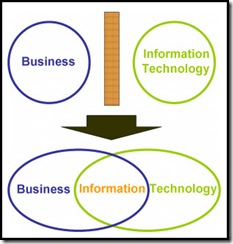
This diagram was published in the July 2009 blog post Business Information Technology by Steve Tuck of Datanomic, and was based on a conference conversation with Gwen Thomas of the Data Governance Institute, about the figurative wall, prevalent in most organizations, which literally separates the Business, who usually own its data and understand its use in making critical daily business decisions, from Information Technology (IT), who usually own and maintain the hardware and software infrastructure of its enterprise data architecture.

The success of all enterprise information initiatives requires that this wall be torn down, ending the conflict between the Business and IT, and forging a new collaborative union that Steve and Gwen called Business Information Technology.


Isn’t IT a part of the Business?

In his recent blog post Isn’t IT a Part of “the Business”?, Winston Chen of Kalido examined this common challenge, remarking how “IT is often a cost center playing a supporting role for the frontline functions.  But Finance is a cost center, too.  Is Finance really the Business?  How about Human Resources?  We don’t hear HR people talk about the Business versus HR, do we?”

“Key words are important in setting the tone for communication,” Winston explained.  “When our language suggests IT is not a part of the Business, it cements a damaging us-versus-them mentality.”

“It leads to isolation.  What we need today, more than ever, is close collaboration.”


Purple People

Earlier this year in his blog post “Purple People”: The Key to BI Success, Wayne Eckerson of TDWI used a colorful analogy to discuss this common challenge within the context of business intelligence (BI) programs.

Wayne explained that the color purple is formed by mixing two primary colors: red and blue.  These colors symbolize strong, distinct, and independent perspectives.  Wayne used red to represent IT and blue to represent the Business.

Purple People, according to Wayne, “are key intermediaries who can reconcile the Business and IT and forge a strong and lasting partnership that delivers real value to the organization.”

“Pure technologists or pure business people can’t harness BI successfully.  BI needs Purple People to forge tight partnerships between business people and technologists and harness information for business gain.”

I agree with Wayne, but I believe all enterprise information initiatives, and not just BI, need Purple People for success.


Tearing down the Business-IT Wall

My overly dramatic blog post title is obviously a reference to the famous speech by United States President Ronald Reagan at the Berlin Wall on June 12, 1987.  For more than 25 years, the Berlin Wall had stood as a symbol of not only a divided Germany and divided political ideologies, but more importantly, it was both a figurative and literal symbol of a deeper human divide.

Although Reagan’s speech was merely symbolic of the numerous and complex factors that eventually lead to the dismantling of the Berlin Wall and the end of the Cold War, symbolism is a powerful aspect of human culture—including corporate culture.

The Business-IT Wall is only a figurative wall, but it literally separates the Business and IT in most organizations today.

So much has been written about the need for Business-IT Collaboration on successful enterprise information initiatives that the message is often ignored because people are sick and tired of hearing about it.

However, although there are other barriers to success, and people, process, and technology are all important, by far the most important factor for true and lasting success to be possible is—peoplecollaborating.

Organizations must remove all symbolic obstacles, both figurative and literal, which contribute to the human divide preventing enterprise-wide collaboration within their unique corporate culture.

As for the Business-IT Wall, and all other similar barriers to our collaboration and success, the time is long overdue for us to:

Tear down this wall!

Related Posts

The Road of Collaboration

Finding Data Quality

Data Transcendentalism

Declaration of Data Governance

Podcast: Business Technology and Human-Speak

Not So Strange Case of Dr. Technology and Mr. Business

Data Quality is People!

You're So Vain, You Probably Think Data Quality Is About You

PrintView Printer Friendly Version

EmailEmail Article to Friend

Reader Comments (10)

Great post about the figurative wall.

Too many organizations have an Us versus Them culture that it tends to build the wall. We need to get everyone focused on the same goals and looking at how everyone contributes to them. And you're right we need collaboration to do this.

September 15, 2010 | Unregistered CommenterRob Drysdale

I hope that this divide will grow thinner and thinner.

When the current young generation, who sucked computers from their mother's breast, become dominant in the business environment, then the wall will tumble down once and for all.

In the meantime, I try to be as purple as possible!

September 15, 2010 | Unregistered CommenterStray__Cat

Early in my career, I answered a typical job interview question "What are your strengths?" with:

“I can bring Business and IT together to deliver results.”

My interviewer wryly poo-poo'd my answer with “Business and IT work together well already,” insinuating that such barriers may have existed in the past but were now long gone. I didn't get that particular job, but in the years since I have seen this barrier in action (I can attest that my interviewer was wrong).

What is required for Business Intelligence success is to have smart business people and smart IT people working together collaboratively. Too many times one side or the other says “that's not my job” and enormous potential is left unrealized.

September 16, 2010 | Unregistered CommenterScott Andrews

Jim, in my experience as a data professional I found much more barriers and resistance from IT folks - project managers, developers, and application architects - than from business people.

As long as I remove our technical terminology - keys, referential integrity, constraints, nulls and so forth - from the dialog with people who are responsible for business processes and business decisions, no kind of problem or barrier shows up.

More than this - I ask business people to show me their spreadsheets and - in an hour or two - voilá ! - I came up with a conceptual model of the business subject being analyzed.

Simple like that. Data Administration is a business issue, no more, no less than this.

Best regards from Brazil.

September 16, 2010 | Unregistered CommenterBlog reader from Brazil

Thanks everyone for your comments, your feedback is always greatly appreciated.

@Rob — Sometimes it seems like most organizations believe that Us versus Them is the only type of corporate culture.

@Stray__Cat — In the past, the people who worked for the Business and IT had very different backgrounds, skill sets, and career interests. Today, and especially, as you noted, among the younger generations entering the workplace, technology has become so commonplace that these differences are starting to greatly diminish.

@Scott — Yes, some people ignore the problem as if it no longer existed, which is almost understandable since you would think with so much having been written, and for so long, that this problem would simply no longer exist.

@Blog reader from Brazil — While I do not completely disagree with your viewpoint, as I have previously explained (in my Business Technology and Human-Speak podcast) the danger of just saying everything is a business issue is that it can both (a) make IT the villain, and (b) convince the Business that collaborating with IT isn't necessary.

September 16, 2010 | Registered CommenterJim Harris

Somewhere I once worked pushed hard on breaking down this divide.

I really liked the language we used: "functional" business units and "technical" business units.

It still leaves some divide, but it does acknowledge the fact that we're all equal parts of the same business organization.

That may be a valuable step for some cultures.

September 16, 2010 | Unregistered CommenterPaul Boal

Great post Jim. I love your comment:

"By far the most important factor for true and lasting success to be possible is—people—collaborating."

I couldn't agree more.

It amazes me (ok, not really...it makes me cynical and want to rant...) how often Business and IT SAY they are collaborating, but it's obvious they have varying views and perspectives on what collaboration is and what the expected outcomes should be. Business may think collaboration means working together for a solution, IT may think it means IT does the dirty work so Business doesn't have to.

Either way, why don't they just start the whole process by having a (honest and open) chat about expectations and that INCLUDES what collaboration means and how they will work together.

And hopefully, (here's where I start to rant because OMG it's Collaboration 101) that includes agreement not to use language such as 'Business' and 'IT', but rather start to use language like 'We'.

Thanks Jim and Happy Friday :)

September 17, 2010 | Unregistered CommenterJill Wanless

Thanks for your great comments, Paul and Jill.

@Paul — I really like the idea of functional business units and technical business units, since, as you said, it acknowledges the fact that we're all equal parts of the same business organization.

@Jill — Great point! Many organizations fail what is known as the pronoun test, and sadly think Collaboration is actually spelled: Co-blame-game-oration :-)

September 17, 2010 | Registered CommenterJim Harris

Over on the SmartData Collective, Gwen Thomas commented:

“Yes - Tear down this wall! As you know, several years ago I vowed to never miss an opportunity to point out the inherent problem with the Business-IT paradigm, instead using the Venn diagram to highlight that instead of B-IT we actually have B-I-T. Working well in the information space does require the right mix of skills and perspective - Wayne's purple people tag is a good way of highlighting this.

Thanks for pulling together the B-I-T model, the purple people metaphor, and the Wall rallying cry.”

And I replied:

Yes, adding another hyphen makes a huge difference (i.e., from B-IT to B-I-T).

Thanks for providing the inspiration for this blog post.


And Gary Cokins commented:

“You are making an important point. My sense though is that rather than be critical of IT a positive and motivating approach should be to observe with IT:

"This is your opportunity. Articles proclaim IT should bring value. This is your chance."

IT likes standardization (e.g., batch processing, workflows). Increasing users want easy access to and flexibility with data ... and the ability to manipulate it. This is especially true with business analytics where users want to explore and test hypothesis for insights. This cannot be standardized. A compromise will be needed.”

And I replied:

Hopefully I didn't (despite the strong metaphor) come across as critical of either IT or the Business.

I definitely agree that a positive and motivating approach is better than criticism.

September 28, 2010 | Registered CommenterJim Harris
October 26, 2010 | Registered CommenterJim Harris

PostPost a New Comment

Enter your information below to add a new comment.

My response is on my own website »
Author Email (optional):
Author URL (optional):
Post:
 
Some HTML allowed: <a href="" title=""> <abbr title=""> <acronym title=""> <b> <blockquote cite=""> <code> <em> <i> <strike> <strong>