
MacGyver: Data Governance and Duct Tape
/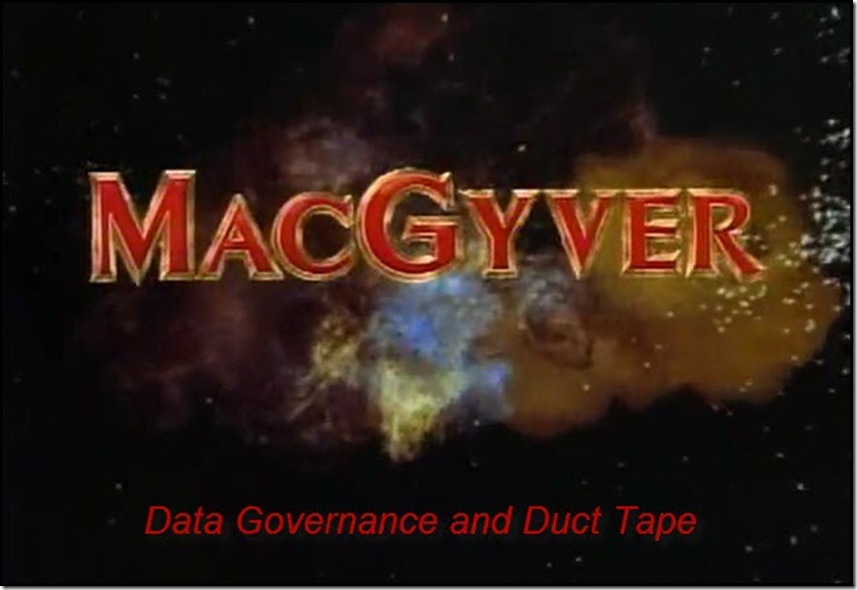
One of my favorite 1980s television shows was MacGyver, which starred Richard Dean Anderson as an extremely intelligent and endlessly resourceful secret agent, known for his practical application of scientific knowledge and inventive use of common items.
While I was thinking about the role of both data stewards and data cleansing within a successful data governance program, the two things that immediately came to mind were MacGyver, and the other equally versatile metaphor for versatility—duct tape.
I decided to combine these two excellent metaphors by envisioning MacGyver as a data steward and duct tape as data cleansing.
Data Steward: The MacGyver of Data Governance
Since “always prepared for adventure” was one of the show’s taglines, I think MacGyver would make an excellent data steward.
The fact that the activities associated with the role can vary greatly, almost qualifies “data steward” as a MacGyverism. Your particular circumstances, and especially the unique corporate culture of your organization, will determine the responsibilities of your data stewardship function, but the general principles of data stewardship, as defined by Jill Dyché, include the following:
- Stewardship is the practice of managing or looking after the well being of something.
- Data is an asset owned by the enterprise.
- Data stewards do not necessarily “own” the data assigned to them.
- Data stewards care for data assets on behalf of the enterprise.
Just like MacGyver’s trusted sidekick—his Swiss Army knife—the most common trait of a data steward may be versatility.
I am not suggesting that a data steward is a jack of all trades, but master of none. However, a data steward often has a rather HedgeFoxian personality, thereby possessing the versatility necessary to integrate disparate disciplines into practical solutions.
In her excellent article Data Stewardship Strategy, Jill Dyché outlined six tried-and-true techniques that can help you avoid some common mistakes and successfully establish a data stewardship function within your organization. The second technique provides a few examples of typical data stewardship activities, which often include assessing and correcting data quality issues.
Data Cleansing: The Duct Tape of Data Quality
About poor data quality, MacGyver says, “if I had some duct tape, I could fix that.” (Okay—so he says that about everything.)
Data cleansing is the duct tape of data quality.
Proactive defect prevention is highly recommended, even though it is impossible to truly prevent every problem before it happens, because the more control enforced where data originates, the better the overall quality will be for enterprise information.
However, when poor data quality negatively impacts decision-critical information, the organization may legitimately prioritize a reactive short-term response—where the only remediation will be finding and fixing the immediate problems.
Of course, remediation limited to data cleansing alone will neither identify nor address the burning root cause of those problems.
Effectively balancing the demands of a triage mentality with a best practice of implementing defect prevention wherever possible, will often create a very challenging situation for data stewards to contend with on a daily basis. However, like MacGyver says:
“When it comes down to me against a situation, I don’t like the situation to win.”
Therefore, although comprehensive data remediation will require combining reactive and proactive approaches to data quality, data stewards need to always keep plenty of duct tape on hand (i.e., put data cleansing tools to good use whenever necessary).
The Data Governance Foundation
In the television series, MacGyver eventually left the clandestine service and went to work for the Phoenix Foundation.
Similarly, in the world of data quality, many data stewards don’t formally receive that specific title until they go to work helping to establish your organization’s overall Data Governance Foundation.
Although it may be what the function is initially known for, as Jill Dyché explains, “data stewardship is bigger than data quality.”
“Data stewards establish themselves as adept at executing new data governance policies and consequently, vital to ongoing information management, they become ambassadors on data’s behalf, proselytizing the concept of data as a corporate asset.”
Of course, you must remember that many of the specifics of the data stewardship function will be determined by your unique corporate culture and where your organization currently is in terms of its overall data governance maturity.
Although not an easy mission to undertake, the evolving role of a data steward is of vital importance to data governance.
The primary focus of data governance is the strategic alignment of people throughout the organization through the definition, and enforcement, of policies in relation to data access, data sharing, data quality, and effective data usage, all for the purposes of supporting critical business decisions and enabling optimal business performance.
I know that sounds like a daunting challenge (and it definitely is) but always remember the wise words of Angus MacGyver:
“Brace yourself. This could be fun.”
Related Posts
Jack Bauer and Enforcing Data Governance Policies
Live-Tweeting: Data Governance
Follow OCDQ
If you enjoyed this blog post, then please subscribe to OCDQ via my RSS feed, my E-mail updates, or Google Reader.
You can also follow OCDQ on Twitter, fan the Facebook page for OCDQ, and connect with me on LinkedIn.