
The Circle of Quality
/
Explaining why data quality is so vitally important to an organization's success that it needs to be viewed as a corporate asset is unfortunately not an easy task to accomplish.
A common mistake made during such attempts is failing to frame data quality issues in a business context, which leads the organization's business stakeholders to understandably mistake data quality for a purely technical issue apparently lacking any tangible impact on their daily business decisions.
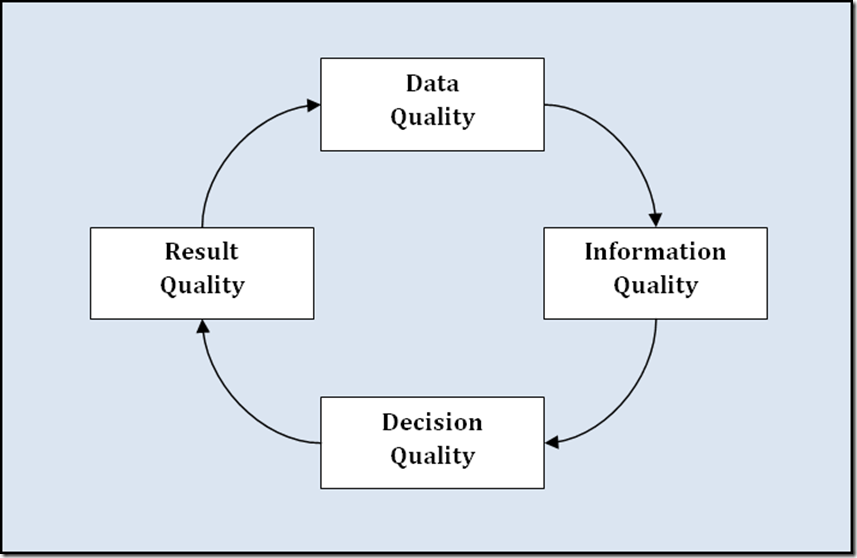
An organization's success is measured by the quality of the results it produces. The results are dependent on the quality of its business decisions. Those decisions rely on the quality of its information. That information is based on the quality of its data.
Therefore, data must be viewed as a corporate asset because high quality data serves as a solid foundation for business success.
As the above diagram illustrates, quality is a fundamental requirement and success criterion all throughout the interconnected Data–>Information–>Decision–>Result business context continuum, which I refer to as The Circle of Quality.
The Circle of Quality
Peter Benson of the ECCMA explains that data is intrinsically simple and can be divided into one of two categories:
- Master Data – data that identifies and describes things
- Transaction Data – data that describes events
In other words, master data is an abstract description of the real-world entities with which the organization conducts business (e.g., customers and vendors). Transaction data is an abstract description of the real-world interactions that the organization has with those entities (e.g., sales and purchases).
Although a common definition for data quality is fitness for the purpose of use, the common challenge is that all data has multiple uses—and each specific use has its own specific fitness requirements.
Viewing each specific use as the information that is derived from data, I define information as data in use or data in action.
Although data's quality can be objectively measured separate from its many uses (i.e., data can be fit to serve as at least the basis for each and every purpose), information's quality can only be subjectively measured according to its specific use.
Therefore, information is being customized to meet the subjective needs of a particular business unit and/or a particular tactical or strategic initiative. In other words, the information is being used as the basis for making a critical business decision.
The quality of the decision is measured by the business result that it produces. Of course, the reality is that the result is often not immediate and also contingent upon a complex interplay of multiple business decisions.
The result can also produce more data, which could come in the form of new transaction data associated with either existing master data (e.g., sales to existing customers) or new master data (e.g., purchases from new vendors).
Either way, with the arrival of this new data, yet another spin around The Circle of Quality begins all over again . . .
Conclusion
The Circle of Quality illustrates the interconnected business context continuum formed by data, information, decisions, and results. Additionally, it demonstrates the need for a sustained enterprise-wide program of data governance and data quality, which is necessary for managing data as a corporate asset.
The Circle of Quality also helps illustrate the true challenge of root cause analysis, where poor quality could be occurring in one or more places within the business context continuum.
And of course, even total quality management is no guarantee of success since it is certainly possible to have high quality data, derive high quality information from it, and then make high quality business decisions based upon it—but still get poor results.
However, it's also easy to imagine the highly questionable results produced when data quality is not considered vital to an organization's success. Therefore, not managing data as a corporate asset is nothing less than extremely risky business.
Related Posts
Beyond a “Single Version of the Truth”
DQ-Tip: “Don't pass bad data on to the next person...”
The Only Thing Necessary for Poor Data Quality
Hyperactive Data Quality (Second Edition)
The General Theory of Data Quality
Data Governance and Data Quality
The Data-Information Continuum