The Road of Collaboration
Jim Harris in
Data Quality tagged
Business-IT Collaboration,
Data Governance,
Philosophy,
Robert Frost
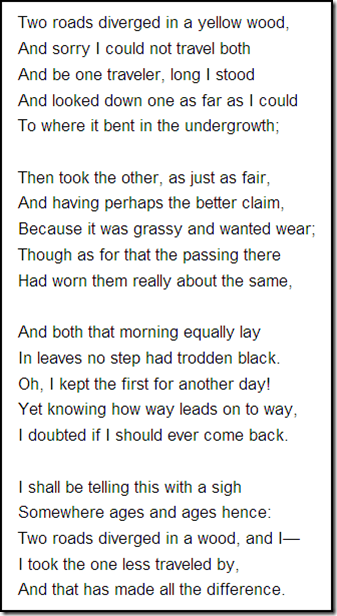
Thursday, August 19, 2010 at 3:00AM I grew up and lived most of my life in the suburbs of Boston, Massachusetts. But just prior to relocating to the Midwest for work seven years ago, I lived in Derry, New Hampshire, just down the road from the historic landmark where Robert Frost, the famous American poet who was also a four-time recipient of the Pulitzer Prize for Poetry, wrote many of his best poems, including the one shown to the left, The Road Not Taken, which has always remained one of my favorite poems—and also provides the inspiration for this blog post.
Historically, there have been only two “roads” diverged in the corporate world, two well-traveled ways: The Road of Business and The Road of Technology.
Although these two roads have a common starting point near the center of an organization, they will almost always extend away from each other, and in completely opposite directions, leaving most employees to choose which road they wish to travel—often without being sorry that they could not travel both.
I don’t believe that I am taking too much of a poetic license in describing this common calamity as how an organization is “a house divided against itself,” which to paraphrase Abraham Lincoln, cannot succeed. I believe that no organization can succeed as half business and half technical. But I also do not believe that any organization must become either all business or all technical.
There is a third option—there is a third road diverged in the corporate world.
Organizations struggle with the business/technical divided house because they believe the corporate world is comprised of technical workers delivering and maintaining the things that enable business workers to do their things.
And of course, there can be an almost Lincoln–Douglas debate about what exactly each of those things are because, in part, it is commonly perceived that they operate independently of one another—whereas the truth is that they are highly interdependent.
However, it’s no debate that organizations suffer from this perception of a deep divide separating the business side of the house, who usually own its data and understand its use in making critical daily business decisions, from the technical side of the house, who usually own and maintain its hardware and software infrastructure, which comprise its enterprise data architecture.
The success of all enterprise information initiatives is highly dependent upon enterprise-wide interdependence—aka collaboration.
Therefore, in order for success to be possible with data quality, data integration, master data management, data warehousing, business intelligence, data governance, etc., your organization needs to travel the third road diverged in the corporate world.
The Road of Collaboration is long and winding, a seemingly strange and unfamiliar road, quite distinct from the well-traveled, long, but straight and narrow, and somewhat easily foreseeable paths of The Road of Business and The Road of Technology.
Your organization must abandon the comforts of the familiar roads and embrace the discomfort of the unfamiliar road, the road that although less traveled by, definitely makes all the difference between whether your entire house will succeed or fail.
But if The Road of Collaboration does not yet exist within your organization, then you can not afford to settle for continuing to travel down whatever path you currently follow. Instead, you must follow the trailblazing advice of Ralph Waldo Emerson:
“Do not go where the path may lead; go instead where there is no path and leave a trail.”
Neither trailblazing, nor taking the road less traveled by, will be an easy journey. And there is no escaping the harsh reality that The Road of Collaboration will always be the path of the greatest resistance.
But which story do you want to be telling—and without a sigh—somewhere ages and ages hence?
Do you want to tell the story about how your organization continued to walk away from each other by traveling separately down The Road of Business and The Road of Technology—leaving The Road of Collaboration as The Road Not Taken?
Or do you want to tell the story about how your organization chose to walk together by traveling The Road of Collaboration?
Three roads diverged in the corporate world, and our organization—
Our organization took the one less traveled by,
And that has made all the difference.
Related Posts
Declaration of Data Governance
Jack Bauer and Enforcing Data Governance Policies
Podcast: Business Technology and Human-Speak
The Dumb and Dumber Guide to Data Quality
Not So Strange Case of Dr. Technology and Mr. Business



Reader Comments (9)
Insightful post, Jim.
The road less traveled is always the road that will bring about change hence most of the work we do is on that road.
The challenge is getting others to hop in the car for the ride, not knowing where they may end up.
To me, that's what makes it so awesome!
Jill
Thanks for your comment, Jill.
It's always great to hear from another traveler of the road less traveled. I definitely agree that most of our work is done on that road, and it is indeed awesome not always knowing where we may end up :-)
Best Regards,
Jim
Wow- Lincoln, Douglas AND Frost all in one post!
As another traveler of the road less traveled and at times shouting "Collaboration" into the seemingly empty wilderness, I agree with the need for another road.
I disagree that the two main roads are truly divergent. More often than not they are a highway and a service road or a freeway next to a minor highway running next to each other with only minor deviations. Technology too often soups up the current path instead of taking the business to new places.
Collaboration also does not mean one area of the business talking to technology. It is the more holistic approach that will elevate an organization and make new products, services and delivery methods possible.
Quick wins are good for morale but silos of success do not get one as far down the road if we are leaving key players at the crossroads. Exception being if said players wish to learn how to play guitar...with the Devil they know.
Thanks for your comment, Corinna.
Shout, shout, let it all out. Collaboration is the thing that we can't do without :-)
Yes, The Road of Business and The Road of Technology are not truly divergent, but travel a somewhat adjacent trajectory.
Absent a common language, these corporate traveling companions often struggle to communicate.
Robert Frost once wrote that “poetry is what gets lost in translation,” but the typical results of the inability of business and technical travelers to communicate could only be called really bad poetry, perhaps the fourth worst poetry in the Universe, behind only Vogon Poetry, Azgoths of Kria, and Paula Nancy Millstone Jennings of Sussex :-)
Best Regards,
Jim
“Wow” - actually the first expression that came into my mind having finished reading this article (before I saw that one of the previous comments begins with exactly this term).
I regret not having seen this post earlier (got my attention following today’s Twitter Redux). This is definitely one of the “99” best articles (if there even are so many) about one of the greatest lacks in today’s organizations. Your post can serve as a wake-up call to the inert corporate leaders as well as an encouragement for the “brave” that decided to travel jointly.
Jim, thank you for this article.
Best regards,
Axel
Thanks for your comment, Axel.
Collaboration is one of my favorite topics, and this was one of my favorite blog posts that I have written about it, so I was happy to hear that you enjoyed it. Also happy a Twitter Redux (i.e., a re-tweet of an old blog post) found a new reader :-)
Best Regards,
Jim
Great post, Jim.
It is sad to see so many enterprises handicapped, often crippled, by the clash between the business and the ego that is the IT Department. The trouble is that so many support departments in enterprises actually believe that they run, or ought to run, the organisation. This is especially so with IT Departments, Finance Departments and, less frequently, HR Departments.
The problem is often compounded by history as computing in enterprises often started in the Finance Department. This doubled the size of the ego. When other business departments started to see the advantages that this new technology could bring to them the Finance Department had already been established as "experts" who thought they could best decide what was best for the rest of the business.
This is where the rift started. Sadly, as long as support departments continue to suffer from the delusion that they should control the business the rift will continue. Because of this continuing rift, the quality of computing systems and associated data has, if anything, declined rather improved over the last 25 years. Computing departments need to put principles before personalities. Their role is to support the business not run it.
There are two industries that consistently refer to their customers as "users". The first is computing, the second is drug pushers! There is a great amount of evidence to support the view that the former treat their customers with more respect than the latter and do them a lot less lasting damage.
I come from an IT background and I totally agree that there is another path and, when taken, brings immense benefits to both the business and IT professionals involved.
Regards,
John
Thanks for your comment, John.
Support versus Control is a common challenge undercutting the collaborative efforts of most organizations.
I believe all departments are support departments because the organization’s successes are the shared responsibility of the entire enterprise. Although there will obviously be times when one department or a few individuals receive more accolades, it is important to remember that the support provided by enterprise-wide collaboration is the root cause of lasting success.
Best Regards,
Jim
Great post, Jim.
As I read this, I couldn't help thinking how big a part fear of the unknown has to play in the business / IT divide.
Much like cultural diversity, most business managers feel much more comfortable talking to customers about their plans than those skinny guys who keep muttering foreign phrases like "bitmap indexes" and "temp tablespace". Likewise, there's nothing more annoying to a DBA than THAT manager who keeps phoning from Hamilton insisting she needs a historical customer report when he's already told her clearly the table she wants to report on isn't an SCD type 2, and there's no way to create it without duplicating lots of data.
Building that culture of collaboration means understanding and addressing those fears, and annecdotally I've noticed the organisations that embrace differences in other areas also seem to have more sophisticated data management practices. I suspect that's not a coincidence.
If Frost had had data governance in mind when he penned his poem "then took the other, just as fair" would have become "then stuck with the first one, because quite frankly that other one scares the hell out of me".
Hmmm. Maybe I'll stick to my day job!