
The Idea of Order in Data
Jim Harris in
Data Quality tagged
Data Governance,
Master Data Management,
Philosophy,
Wallace Stevens
Sunday, August 8, 2010 at 3:00AM As I explained in my previous post, which used the existentialist philosophy of Jean-Paul Sartre to explain the existence of the data silos that each and every one of an organization’s business units rely on for maintaining their own version of the truth, I am almost as obsessive-compulsive about literature and philosophy as I am about data and data quality.
Therefore, since my previous post was inspired by philosophy, I decided that this blog post should be inspired by literature.
Wallace Stevens
Although he consistently received critical praise for his poetry, Wallace Stevens spent most of his life working as a lawyer in the insurance industry. After winning the Pulitzer Prize for Poetry in 1955, he was offered a faculty position at his alma mater, Harvard University, but declined since it would have required his resignation from his then executive management position.
Therefore, Wallace Stevens was somewhat unique in the sense he was successful both as an artist and as a business professional, which is one of the many reasons why he remains one of my favorite American poets.
Stevens believed that reality is the by-product of our imagination as we use it to shape the constantly changing world around us. Since change is the only constant in the universe, reality must be acknowledged as an activity, whereby we are constantly trying to make sense of the world through our re-imagining of it—our endless quest to discover order and meaning amongst the chaos.
The Idea of Order in Data
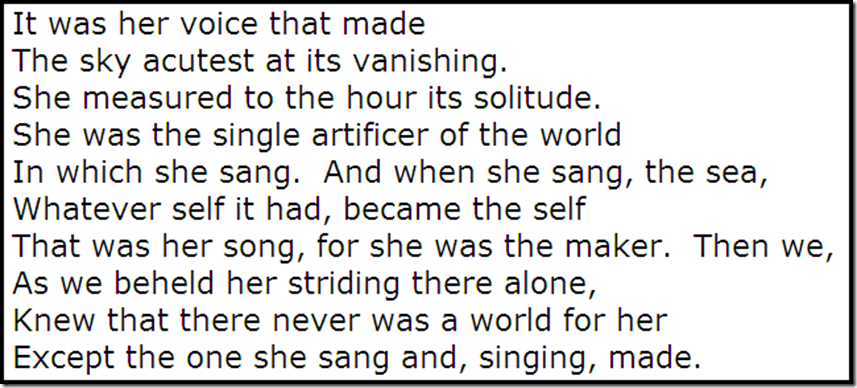
This is an excerpt from The Idea of Order at Key West, one of my favorite Wallace Stevens poems, which provides an example of how our re-imagining of reality shapes the world around us, and allows us to discover order and meaning amongst the chaos.
“People cling to their personal data sets,” explained James Standen of Datamartist in his comment on my previous post.
Even though their business unit’s data silos are “insulated from all those wrong ideas” created and maintained by the data silos of other business units, as Standen wisely points out, all data silos are often considered “not personal enough for the individual.”
“Microsoft Excel lets people create micro-data silos,” Standen continued. These micro-data silos (i.e., their personal spreadsheets) are “complete (for them), accurate (for them, or at least, they can pretend they are) and constant (in that no matter how much the data in the source system or other people’s spreadsheets change, their spreadsheet will be comfortingly static). It doesn’t matter what the truth is, as long as they believe their version, and insulate themselves from dissenting views/data sets.”
This insidious pursuit truly becomes a Single Version of the Truth because it represents an individual’s version of the truth.
The individual is the single artificer of the only world for them—the one that their own private data describes—thereby allowing them to discover their own personal order and meaning amongst the chaos of other, and often conflicting, versions of the truth.
However, any single version of the truth will only discover a comfortingly static, and therefore false order, as well as an artificial, and therefore misleading meaning, amongst the chaos.
Data is a by-product of our re-imagining of reality. Data is our abstract description of real-world entities (i.e., “master data”) and the real-world interactions (i.e., “transaction data”) among entities. Our creation and maintenance of these abstract descriptions of reality shapes our perception of the constantly changing and rapidly evolving business world around us.
Since change is the only constant, we must acknowledge that The Idea of Order in Data requires a constant activity, whereby we are constantly trying to make sense of the business world through our analysis of the data that describes it, which requires our endless quest to discover the business insight amongst the data chaos.
This quest is bigger than a single individual—or a single business unit. This quest truly requires an enterprise-wide collaboration, a shared purpose that dissolves the barriers—data silos, politics, and any others—which separate business units and individuals.
The Idea of Order in Data is a quest for a Shared Version of the Truth.
Related Posts
Beyond a “Single Version of the Truth”
Is your data complete and accurate, but useless to your business?
Declaration of Data Governance



Reader Comments (6)
What I like about you, Jim, is your ability to cocoonize raw business ideas into shiny shells of culture.
Spreadsheets are comfortably static and accurate as only micro silos are. That's exactly the idea fought by data warehousing professionals, which I think it should be empowered instead.
Data from a single source will forcibly apply rules that are likely not appropriate for everyone's abstraction. And that's the whole point! The only one care is making all the abstractions related just to know what everybody is doing.
Thanks for your comment Augusto (aka Stray__Cat), your feedback, as always, is greatly appreciated.
The problem that I have always had with advocating a Single Version of the Truth is that it can sound like there is only one valid enterprise-wide definition for data, such as, to use a very common example, a master data object such as customer.
I advocate a Shared Version of the Truth since most organizations suffer from a lack of a shared business understanding.
The enterprise must endeavor to define, deliver, enforce, and maintain a highest common denominator to be used by all business units as an objective data foundation, while at the same time, allow what is necessary to meet the justifiable subjective data needs of each business unit.
Although that sounds like a contradiction, it is not, and although definitely not easy to achieve, it is far more useful than the oversimplification of a Single Version of the Truth, which Tom Redman rightfully refers to as the One Lie Strategy.
A Shared Version of the Truth enforces a consistent enterprise understanding of data, but also provides the data (well, technically the information) necessary to support day-to-day operations.
My blog post Beyond a “Single Version of the Truth” discusses all of this in more detail.
Best Regards,
Jim
Another great post Jim!
Big big challenges! We are attempting to do this within our organization and starting with mapping out each business unit's customer lifecycle process. Each process will be linked to business unit and corporate objectives and within each process the data will identified for each stage (including triggers, inputs, outputs, etc).
The expectation is we will see overlap and redundancy and all kinds of fun where multiple units are using the same data for different objectives that aren't linked to corporate objectives.
And in order to identify those shared purposes, agree upon those highest common denominators, I don't see how you can do it without first mapping out the lifecycle. The resolution and/or agreement of those denominators will be our newly established governing council with some new governing policies.
I would love to hear your thoughts on this approach.
Did I say we were having fun? Well I am anyway. The initial work to do this is almost done and I will for sure write about the results and what we learned through the process.
Jill :)
Thanks for your detailed comment, Jill.
I always enjoy hearing about the methodology being used at your organization.
I agree a thorough assessment of the existing business processes, data sources, and technical architecture of each business unit is essential for identifying the usage, interdependencies, and redundancies throughout the enterprise data lifecycle.
A small, but dedicated, and cross-functional data governance team, including executive sponsors, data stewards, as well as business and technical stakeholders from throughout the organization, can help guide these efforts, as well as define, document, communicate, and track the governing policies, which sounds like the approach that you're implementing.
I am not surprised to hear that you are having fun, since it sounds like fun to me too :-)
I am looking forward to reading your blog posts about your results and lessons learned.
Best Regards,
Jim
"This quest is bigger than a single individual—or a single business unit. This quest truly requires an enterprise-wide collaboration, a shared purpose that dissolves the barriers—data silos, politics, and any others—which separate business units and individuals."
So achieving good master data management is just as easy and straightforward as achieving world peace?
Paige
@Paige — Yes, exactly — achieving good master data management is just as easy peasy as achieving world peace :-)