
Days Without A Data Quality Issue
/In 1970, the United States Department of Labor created the Occupational Safety and Health Administration (OSHA). The mission of OSHA is to prevent work-related injuries, illnesses, and deaths. Based on statistics from 2007, since OSHA's inception, occupational deaths in the United States have been cut by 62% and workplace injuries have declined by 42%.
OSHA regularly conducts inspections to determine if organizations are in compliance with safety standards and assesses financial penalties for violations. In order to both promote workplace safety and avoid penalties, organizations provide their employees with training on the appropriate precautions and procedures to follow in the event of an accident or an emergency.
Training programs certify new employees in safety protocols and indoctrinate them into the culture of a safety-conscious workplace. By requiring periodic re-certification, all employees maintain awareness of their personal responsibility in both avoiding workplace accidents and responding appropriately to emergencies.
Although there has been some debate about the effectiveness of the regulations and the enforcement policies, over the years OSHA has unquestionably brought about many necessary changes, especially in the area of industrial work site safety where dangerous machinery and hazardous materials are quite common.
Obviously, even with well-defined safety standards in place, workplace accidents will still occasionally occur. However, these standards have helped greatly reduce both the frequency and severity of the accidents. And most importantly, safety has become a natural part of the organization's daily work routine.
A Culture of Data Quality
Similar to indoctrinating employees into the culture of a safety-conscious workplace, more and more organizations are realizing the importance of creating and maintaining the culture of a data quality conscious workplace. A culture of data quality is essential for effective enterprise information management.
Waiting until a serious data quality issue negatively impacts the organization before starting an enterprise data quality program is analogous to waiting until a serious workplace accident occurs before starting a safety program.
Many data quality issues are caused by a lack of data ownership and an absence of clear guidelines indicating who is responsible for ensuring that data is of sufficient quality to meet the daily business needs of the enterprise. In order for data quality to be taken seriously within your organization, everyone first needs to know that data quality is an enterprise-wide priority.
Additionally, data quality standards must be well-defined, and everyone must accept their personal responsibility in both preventing data quality issues and responding appropriately to mitigate the associated business risks when issues do occur.
Data Quality Assessments
The data equivalent of a safety inspection is a data quality assessment, which provides a much needed reality check for the perceptions and assumptions that the enterprise has about the quality of its data.
Performing a data quality assessment helps with a wide variety of tasks including: verifying data matches the metadata that describes it, preparing meaningful questions for subject matter experts, understanding how data is being used, quantifying the business impacts of poor quality data, and evaluating the ROI of data quality improvements.
An initial assessment provides a baseline and helps establish data quality standards as well as set realistic goals for improvement. Subsequent data quality assessments, which should be performed on a regular basis, will track your overall progress.
Although preventing data quality issues is your ultimate goal, don't let the pursuit of perfection undermine your efforts. Always be mindful of the data quality issues that remain unresolved, but let them serve as motivation. Learn from your mistakes without focusing on your failures – focus instead on making steady progress toward improving your data quality.
Data Governance
The data equivalent of verifying compliance with safety standards is data governance, which establishes policies and procedures to align people throughout the organization. Enterprise data quality programs require a data governance framework in order successfully deploy data quality as an enterprise-wide initiative.
By facilitating the collaboration of all business and technical stakeholders, aligning data usage with business metrics, enforcing data ownership, and prioritizing data quality, data governance enables effective enterprise information management.
Obviously, even with well-defined and well-managed data governance policies and procedures in place, data quality issues will still occasionally occur. However, your goal is to greatly reduce both the frequency and severity of your data quality issues.
And most importantly, the responsibility for ensuring that data is of sufficient quality to meet your daily business needs, has now become a natural part of your organization's daily work routine.
Days Without A Data Quality Issue
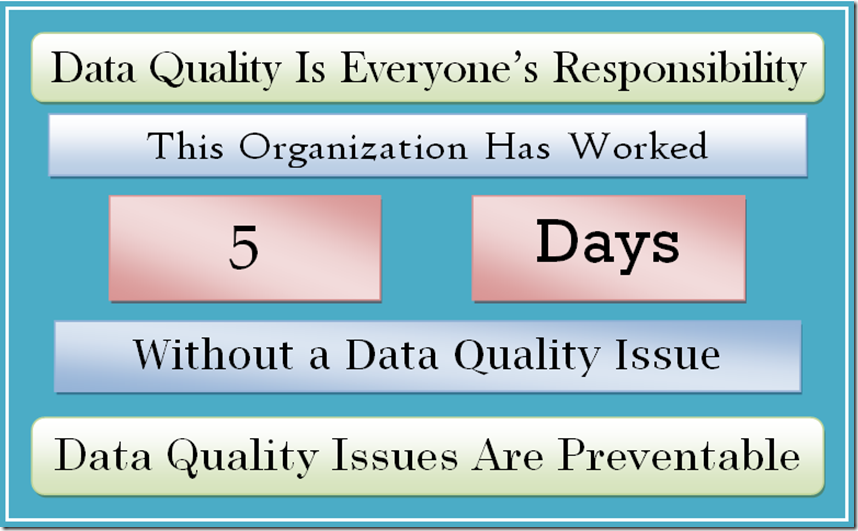
Organizations commonly display a sign indicating how long they have gone without a workplace accident. Proving that I certainly did not miss my calling as a graphic designer, I created this “sign” for Days Without A Data Quality Issue:
Related Posts
DQ-Tip: “Don't pass bad data on to the next person...”
The Only Thing Necessary for Poor Data Quality
Hyperactive Data Quality (Second Edition)
Data Governance and Data Quality