
Jim Harris

My name is Jim Harris, I am the Blogger-in-Chief of OCDQ Blog, and an independent consultant, speaker, and freelance writer for hire.

My Services Contact Me
Search OCDQ Blog
Recent Comments
« Do you believe in Magic (Quadrants)? | Main | Channeling My Inner Beagle: The Case for Hyperactivity »
Monday
Jun282010

The Great Rift

I recently read a great article about social collaboration in the enterprise by Julie Hunt, which includes the excellent insight:

“Most enterprises have failed to engender a ‘collaboration culture’ based on real human interaction.  The executive management of many companies does not even understand what a ‘collaboration culture’ is.  Frankly, executive management of many companies is hard put to authentically value employees—these companies want to de-humanize employees with such terms as ‘resources’ and ‘human capital’, and think that it is enough if they sling around a few ‘mission statements’ claiming that they ‘value’ employees.”

Even though the article was specifically discussing the reason why companies struggle to effectively use social media in business, it reminded me of the reason that many enterprise initiatives struggle—if not fail—to live up to their rather lofty expectations.

The most common root cause for the failure of enterprise initiatives is what I like to refer to as The Great Rift.


The Great Rift

In astronomy, the Great Rift—also known as the Dark Rift—is a series of overlapping and non-luminous molecular dust clouds, which appear to create a dark divide in the otherwise bright band of stars and other luminous objects comprising our Milky Way.

Within the intergalactic empires of the business world, The Great Rift is a metaphor for the dark divide separating how most of these organizations would list and prioritize their corporate assets:
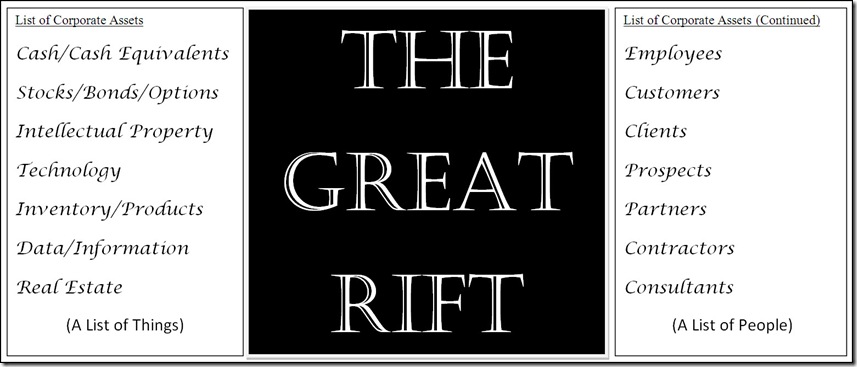
Please note that a list of things is on the left side of The Great Rift and on the right side is a list of people. 

Although the order of importance given to the items within each of these lists is debatable, I would argue what is not debatable is that the list of things is what most organizations prioritize as their most important corporate assets.

It is precisely this prioritization of the value of things over the value of people that creates and sustains The Great Rift.

Of course, the message delivered by corporate mission statements, employee rallies, and customer conferences would lead you to believe the exact opposite is true—and in fairness, some organizations do prioritize the value of people over the value of things.

However, the harsh reality of the business world is that the message “we value our people” is often only a Machiavellian illusion.

I believe that as long as The Great Rift exists, then no enterprise initiative can be successful—or remain successful for very long. 

The enterprise-wide communication and collaboration that is so critical to achieving and sustaining success on initiatives such as Master Data Management (MDM) and Data Governance, can definitely not escape the effects of The Great Rift. 

Eventually, The Great Rift becomes the enterprise equivalent of a black hole, where not even the light shining from your very brightest stars will be able to escape its gravitational pull.

“Returning to the human side of business won’t happen magically,” Julie Hunt concluded her article.  “It will take real work and real commitment, from the executive level through all levels of management and employee departments.”

I wholeheartedly agree with Julie and will therefore conclude this blog post by paraphrasing the lyrics from “Yellow” by Coldplay into a song I am simply calling “People” because repairing The Great Rift and “returning to the human side of business” can only be accomplished by acknowledging that every organization’s truly most important corporate asset is—their people.

Rumors have it that the The Rolling Forecasts might even add the song to their playlist for the Data Rock Star World Tour 2010.


People

Look at your people
Look how they shine for you
And in everything they do
Yeah, they’re all stars

They came along 
They wrote a song for you
About all the Things they do
And it was called People

So they each took their turn 
And sung about all the things they’ve done
And it was all for you

Your business
Oh yeah, your technology and your data too
They turned it all into something beautiful
Did you know they did it for you?
They did it all for you

Now what are you going to do for them?

They crossed The Great Rift
They jumped across for you 
Because all the things you do
Are all done by your people

Look at your stars
Look how they shine
And in everything they do
Look how they shine for you

They crossed the line
The imaginary line drawn by you
Oh what a wonderful thing to do
And it was all for you

Your business
Oh yeah, your technology and your data too
They turned it all into something beautiful
Did you know they did it for you?
They did it all for you

Now what are you going to do for them?

Look at your people, they’re your stars, it’s true
Look how they shine
And in everything they do
Look how they shine for you

Look at your people
Look at your stars
Look how they shine
And in everything they do
Look how they shine for you

Now what are you going to do for them?

PrintView Printer Friendly Version

EmailEmail Article to Friend

Reader Comments (10)

It starts at the top. I keep harping on about Zappo's but look at the value they were sold for, Amazon were forced to buy them out because they were selling shoes for a higher price than Amazon simply due to the human respect that flowed from the very top and out to their customers.

I think a collaboration culture starts with employees but must extend outwards, there should be less of a dividing line between workers and customers.

Case in point, I spoke with one company today who is about to sign up one of the smaller of the data quality vendors. One of the critical factors for them was collaboration, several of the bigger names assumed "they had it in the bag" and sat back waiting for the deal whereas the smaller guys listened, collaborated, innovated and supported.

Collaboration won the day, big lesson there for those brands who want to rest on their analyst reports and market presence, if you're not willing to collaborate authentically there are plenty of disruptors who are.

June 29, 2010 | Unregistered CommenterDylan Jones

I have spent most of my career consulting for medium sized businesses; there's a lot of them in Italy.

To the owner, employees are usually a necessary evil. They're people doing what the owner would do much better if only he could. People are a disposable item. There are significant exceptions, but they're minority for sure.

What's astonishing is that the vast majority of employees still work with attention and pride, despite being treated like slackers by default.

June 29, 2010 | Unregistered CommenterStray__Cat

Thanks for your comments, Dylan and Augusto. Your great feedback is always appreciated.

@Dylan — Yes, Zappos is a great example of a company whose culture and core values is the driving force behind everything they do. To all the organizations who simply pay lip service to “we value our people” because they claim (in private, of course) that business success doesn't come from such wishy-washy Kumbaya crap--take note of the fact that Amazon was forced to buy them (for almost one billion dollars) because they were beating Amazon in sales on the exact same products despite the fact that Zappos's prices were higher.

The REAL Bottom Line:

If you value people, people will value your company.
If you take care of people, people will take care of your company.

@Augusto (aka Stray__Cat) — Yes, I have always found it surprising that small to medium businesses also tend to treat their people poorly since smaller groups tend to be more naturally inclined to communication and collaboration, and also in smaller companies, it is much easier to see if management truly walks the talk of “we value our people.” However, like you said, there are significant exceptions--and the vast majority of employees always work with attention and pride.

I truly believe that the future of big business is small to medium sized businesses (SMB). I believe that the unrelenting growth and popularity of the online communities being facilitated by social media are driving the commercial landscape back to a SMB business model. Therefore, in companies of all sizes, a successful future can only be built on a foundation of trust and respect, where the value of people is always prioritized over the value of things.

June 29, 2010 | Registered CommenterJim Harris

Check out this great video of the 2010 Railsconf keynote by Gary Vaynerchuk.

Please be warned: The video contains lots of profanity so NSFW (Not safe for work):

http://garyvaynerchuk.com/post/688601116/railsconf-2010-keynote

The following is the comment that I made regarding the video:

The importance of the “Mom and Pop” skill sets and moving toward the Golden Era of “Small Town Rules” really resonated with me.

Many organizations and businesspeople struggle to understand the value of social media because they attempt to relate to it using a more traditional business perspective.

Therefore, they are very uncomfortable with being personal and acting human while participating in online communities because they believe that would somehow be “unprofessional” behavior.

This viewpoint relates to a common misperception about social media, namely that “social” means “try to act like everyone's friend.”

However, we certainly don’t want organizations to try to act like (or try to become) our friends. In social media, just like any professional or personal interaction, the emphasis needs to be on transparency, which will help build genuine rapport and trust.

I believe the unrelenting growth and popularity of the online communities being facilitated by social media are indeed, like you said, driving the commercial landscape back to a business model reminiscent of small towns.

On Main Street in the small town where I grew up, I remember many small businesses. Although I wasn't necessarily friends with the proprietors of these businesses, they weren't total strangers to me. I saw them around town, in the park walking their dog, on the playground with their kids, and at local sporting events.

In other words, I knew that in addition to being professionals who wanted to sell me something if I visited their business, they were also human beings who weren’t any different than the people I did call my friends.

Social media definitely has the professional potential of big business, but it requires the personal rapport of a small town.

Thanks again for sharing your great insights and your passion for “Team Human.”

June 29, 2010 | Registered CommenterJim Harris

From the LinkedIn Group for Data Quality Pro, Marty Moseley commented:

“I've been in several organizations (present excluded) that have suffered in this regard.

Also, actions speak louder than words - it matters not what's posted on posters displayed prominently in hallways throughout a company, what matters is how companies behave.

And, this is part of a company's DNA, so it's difficult to change for the better, but a virus (a bad hire) can exact damage in a corporate culture very easily and it can be very costly to remedy.”

June 29, 2010 | Registered CommenterJim Harris

I would be careful with statements like:

“Take note of the fact that Amazon was forced to buy them (for almost one billion dollars) because they were beating Amazon in sales on the exact same products despite the fact that Zappos's prices were higher.”

Amazon didn’t “buy them” they traded stock. Trading stock is a cheaper way of acquiring a company that paying cash. The VC got their money out which is ultimately what they want so they can invest it elsewhere. Amazon swallowed a potential competitor which was a great move on their part.

And of course, let’s not forget the other examples of corporate culture like Wal-Mart. There was a lot of press about their friendly culture in the early days but not sure you see that much positive press about them.

Zappos built their company on customer service, which is fine but ultimately they had to sell themselves to Amazon, which leads me to believe that they couldn’t survive on their own just based on their culture. They claim net sales are up since being acquired but how about the bottom line? That’s what counts not culture.

June 29, 2010 | Unregistered CommenterRichard Ordowich

@Richard — First, thank you very much for your comment. All viewpoints are freely accepted on my blog without bias.

Second, thank you for correcting my improper description of the Amazon “acquisition” of Zappos--to avoid any possible additional confusion, I will refer readers to Zappos and Amazon--the e-mail sent by Tony Hsieh (CEO - Zappos.com) on July 22, 2009 to the Zappos employees (and later made publicly available on the Zappos blog, where it still remains).

Third, I am glad that you mentioned Wal-Mart.

“A lot of what goes on these days with high-flying companies and these overpaid CEOs, who're really just looting from the top and aren't watching out for anybody but themselves, really upsets me. It's one of the main things wrong with American business today.”

Do you know who said that?

Sam Walton, who founded Wal-Mart in 1962, and by the time he died in 1992, he had grown Wal-Mart into a $40+ billion dollar enterprise. The “their friendly culture in the early days” as you referred to it, actually persisted throughout the entire tenure of Sam Walton's leadership. He believed that if he looked after people, people would look after him, as well as his company. “We're all working together; that's the secret,” said Walton. And these were not empty words--these words embodied the very culture that drove the company's success for 30 years.

Unfortunately, after he died, Wal-Mart became the kind of company that only believes in the bottom line that you praise over culture, which you dismiss as unimportant.

Culture does count--and in fact, it counts exactly where you think it doesn't--on the bottom line.

I believe that any company, regardless of size or current success, which continues to run their business by valuing things (and especially money) over people (and especially their employees and customers) will not survive in the new economy of the 21st century, where any business not truly “in the people business” will eventually find themselves out of business.

But, of course, that is only my opinion. And I truly respect that it is not yours.

June 29, 2010 | Registered CommenterJim Harris

From the LinkedIn Group for Corporate Planning & Global Industry Segmentation, Karen Farberov - Kotler commented:

“I am not aware of any study being done on the grand total of direct and indirect damage suffered by an organization as a result of a RIFT, but I have witnessed a number of RIFTs to know that the damage is far greater than any initial estimates. Over and above the obvious direct loss of staff who in some way contributed to the organization, the indirect loss is far greater. To name, but a few:

1. Damage caused by the entire workforce being insecure throughout the RIFT period causes the loss of the most valuable employees who start looking around for new opportunities out of insecurity regarding their own position and 9 times out of 10 are offered a better position.

2. The loss of business caused by the loss of a sense of security by the sales staff, who need to be solid in their trust of the organization they represent to be effective in their work.

3. Reduction in sales due to customers and partners wishing to spread the risk by turning to other vendors at least until they regain their trust in the organization's future and stability.

4. Public opinion, being a huge driving force behind company valuation and share price has become the most influential aspect in stock market indicators. In the last few years, you might have noticed a phenomenon in the value of shares that is no longer representative of the objective indicators such as turnover and profit, but rather by subjective aspects such as image and public opinion.

It is a burning issue and too many families are affected, while corporations are affected even more, but are too blinded by the game to realize.

My "few" cents-worth...”

June 30, 2010 | Registered CommenterJim Harris

Couldn't agree more.

I am almost to the point of disgust for the on-going and widespread blatant lack of respect and shoddy treatment of this most valuable resource.

What is amazing to me is that this type of behavior is perpetuated throughout organizations because so called "Leaders" allow it, even encourage it! How these people ever got to be called a "Leader" is beyond me!

A Leader is someone who above all else, sees the value of their people, speaks to others of their value, and truly cares about helping them (by paving the way, knocking down walls and blazing trails) to achieve whatever it is they want to achieve!

I do know some (very few) people who do this very well, and even though their shining light may be dampened by the gravitational pull of "The Rift", they will, with the help of those very people they value, be able to jettison past it, and I for one will follow them.

I love your lyrics. You are definitely a shining star :)

June 30, 2010 | Unregistered CommenterJill Wanless

Thanks for your wonderful comments, Karen and Jill. Your feedback is greatly appreciated.

@Karen — Thanks for sharing your excellently detailed perspective on the side effects that The Great Rift has on people both inside and outside of the company.

@Jill — Leaders definitely have a vital role to play in repairing The Great Rift. Thanks for emphasizing the importance of, and excellently describing the characteristics of, true leadership.

Over on the SmartData Collective:

Terri Rylander commented:

“I think I fell in that rift once! Climbed out and left corporate behind forever. Too bad. I've talked with other corporate drop outs who've experienced the same thing. I do hope that this divide will narrow someday.

I absolutely love your poem/song. You have a way with words!”

Leopoldina Patriani commented:

“Our voice has a unique and personal significance, reveals to us when we face our greatest challenges, change ideas and opinions make us alive again.”

Lauren Bielski commented:

“Really good piece, Jim. Things are necessary [in life] but people are the point.

But it's tricky to do well. When I reported on knowledge management systems and collaboration a few years ago, I was told by the experts that the idea was to create a smart repository and retain institutional knowledge—basically so that when talent walks, down the road, the "smarts" stay behind. (Makes sense.)

But it also makes sense that you need to balance those edicts out with an authentic collaborative culture that makes gains for the people sharing today. And, of course, to your broader message, people need to be treated as if they are valued.”

And I replied:

Thank you very much Terri, Leopoldina, and Lauren for your wonderful comments.

Your feedback is greatly appreciated!

@Terri — I too hope that this divide will at least narrow someday. I am also hopeful that The Great Rift can be fully repaired in some existing companies, as well as never be allowed to form in the first place in some of the new companies just now starting their corporate journey.

@Leopoldina — Thanks for the inspirational words!

@Lauren — Yes, it is vital to a company's survival to capture the tacit knowledge of its people in order to educate others and mitigate the risk when talented people leave the company. Excellent point about how an authentic collaborative culture is both necessary for this to truly happen as well as vital to truly treating people well.

June 30, 2010 | Registered CommenterJim Harris

PostPost a New Comment

Enter your information below to add a new comment.

My response is on my own website »
Author Email (optional):
Author URL (optional):
Post:
 
Some HTML allowed: <a href="" title=""> <abbr title=""> <acronym title=""> <b> <blockquote cite=""> <code> <em> <i> <strike> <strong>