Mind the Gap
/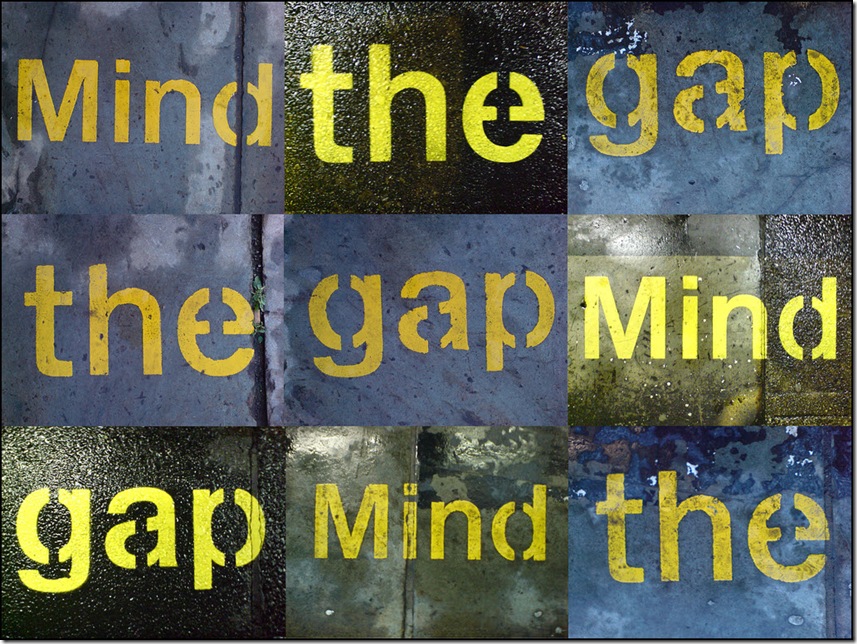
Photo via Flickr (Creative Commons License) by: futureshape
For many people, the phrase “mind the gap” conjures up images of a train platform, and perhaps most notably one used by the London Underground. I’ll even admit to buying the T-shirt during my first business trip to England more than a decade ago.
However, lately I have been thinking about this phrase in a completely different context, specifically in relation to a recurring thought that was provoked by two blog posts, one written by James Chartrand in February, the other by Scott Berkun in May.
The gap I have in mind is the need to coordinate our acquisition of new information with its timely and practical application.
Information Acquisition
The Internet, and even more so, The Great Untethering (borrowing a phrase from Mitch Joel) provided by mobile technology, has created a 24 hours a day, 7 days a week, 365 days a year, world wide whirlwind of constant information flow, where the very air we breath is literally teeming with digital data streams—continually inundating us with new information.
Of course, until they start embedding the computer chips directly into our brains at birth (otherwise known as the top secret iBaby experiment at Apple), we always have the choice of turning off all the devices and giving our full undivided attention to a single source of new information—such as a printed book or, even better, an in-person conversation with another human being.
However, when we are confronted by information overload, its accompanying stress is often caused by the sense that we have some obligation to acquire this new information—as if we were constantly cramming for a perpetually looming pop quiz.
Contrast this perspective with Albert Einstein, who was known for not remembering even some of the most basic equations. He argued why would he waste time memorizing something he could just look up in a book—when he needed it.
This allowed Einstein to focus on problems nobody else could solve, as well as problems nobody had even thought of before, instead of learning what everyone else already knew. He acquired more of his new information from his thought experiments than he did from books or other sources.
Filter Failure
As Clay Shirky famously stated, “it’s not information overload, it’s filter failure.” I agree, but setting our filters is no easy task.
Defending ourselves against information overload has become more difficult precisely because we now have greater individual responsibility for our own filters. Not only are there more published books than ever before, but blogs, and other online sources of new information, have virtually eliminated the “built-in filter” that was provided by publishers, editors, and other gatekeepers.
Please don’t misunderstand me—I am the complete opposite of Andrew Keen—I believe that this is a truly great thing.
However, our time is a zero-sum game, meaning for every book, blog, or other new information source that we choose, others are excluded. There’s no way to acquire all available information. Additionally, cognitive load, a scientific theory that, in part, examines the limitations of our memory, explains why we often don’t remember much of the new information we do acquire.
Limiting ourselves to the few books and blogs we currently have the time to read, still requires filtering a much larger selection in order to make those choices—or we could simply choose to read only bestselling books and the blogs with the highest PageRank.
However, can that approach guarantee access to the most valuable sources of new information? Can any approach do this?
Information Application
Although acquiring new information is always potentially useful, it is when—and if—we can put it to use that makes it valuable.
The distinction between useful and useless information is largely one of applicability. If the gap in time between the acquisition and application of information is too great, then we would need to reacquire it, rendering the previous acquisition a wasted effort.
Perhaps the key point could be differentiating the type of potential knowledge provided by the information. At a very high level, there are two broad categories of knowledge—explicit and tacit.
Explicit Knowledge
Explicit knowledge is relatively easily to acquire from either verbal or written information, and is often easily understood without extensive explanation. Explicit knowledge can be based on a straightforward set of facts, or a specific set of instructions to follow, which after being repeatedly put to practical use just a few times, becomes easy to internalize and later recall when necessary.
The information required for explicit knowledge is often best coordinated around when the knowledge gained would be used.
One example is software training classes. As an instructor, I always recommend minimizing the gap in time between when a training class is taken, and when the students would actually start using the software. Additionally, an introductory class should focus on the most commonly used software features so students can master the basics before approaching advanced concepts.
Tacit Knowledge
Tacit knowledge is not only more difficult to acquire, but it is often not even easily recognizable. Some lessons can simply not be taught, they can only be learned from experience, which is why tacit knowledge is sometimes alternatively defined as wisdom.
One of my favorite quotes about wisdom is from Marcel Proust:
“We do not receive wisdom, we must discover it for ourselves, after a journey through the wilderness, which no one can make for us, which no one can spare us, for our wisdom is the point of view from which we come at last to regard the world.”
Thought-provoking or paradigm-shifting information is often required to get us started on our journey through the wilderness of tacit knowledge, but we can easily lose sight of the deep forest it represents because we are far more immediately concerned with the explicit knowledge provided by the trees.
Whereas explicit knowledge is often more tactical in nature, tacit knowledge is often more strategic. In general, we tend to prioritize short-term tactics over long-term strategy, thereby developing a preference for explicit, and not tacit, knowledge.
With tacit knowledge, the gap in time between information acquisition and application is much wider. You require this time to assess the information before attempting to apply it. You also need to realize that you will fail far more often when applying this type of information—which is to be expected since failure is a natural and necessary aspect of developing tacit knowledge.
Mind the Gap
As the growing stack of unread books on my nightstand, as well as the expanding list of unread blog posts in my Google Reader, can both easily attest, neither filtering nor acquiring new information is an easy task.
I have read many books—and considerably more blog posts—containing new information, which in retrospect, I can not recall.
Obviously, in some cases, their information was neither valuable nor applicable. However, in many cases, their information was both valuable and applicable, but I didn’t find—or more precisely, I didn’t make—the time to either put it to an immediate use, or to use it as inspiration for my own thought experiments.
I am not trying to tell you how to manage your time, or what new information sources to read, or even when to read them.
I simply encourage you to mind the gap between your acquisition of new information and its timely and practical application.
As always, your commendable comments are one of my most valuable new information sources, so please share your thoughts.
Related Posts
Eternal September and Tacit Knowledge
Will people still read in the future?