
Dot Collectors and Dot Connectors
/
The attention blindness inherent in the digital age often leads to a debate about multitasking, which many claim impairs our ability to solve complex problems. Therefore, we often hear that we need to adopt monotasking, i.e., we need to eliminate all possible distractions and focus our attention on only one task at a time.
However, during the recent Harvard Business Review podcast The Myth of Monotasking, Cathy Davidson, author of the new book Now You See It: How the Brain Science of Attention Will Transform the Way We Live, Work, and Learn, explained how “the moment that you start not paying attention fully to the task at hand, you actually start seeing other things that your attention would have missed.” Although Davidson acknowledges that attention blindness is a serious problem, she explained that there really is no such thing as monotasking. Modern neuroscience research has revealed that the human brain is, in fact, always multitasking. Furthermore, she explained how multitasking can be extremely useful for a new and expansive form of attention.
“We all see selectively, but we don’t select the same things to see,” Davidson explained. “So if we can learn to work together, we can actually account for, and productively work around, our own individual attention blindness by seeing collaboratively in a way that compensates for that blindness.”
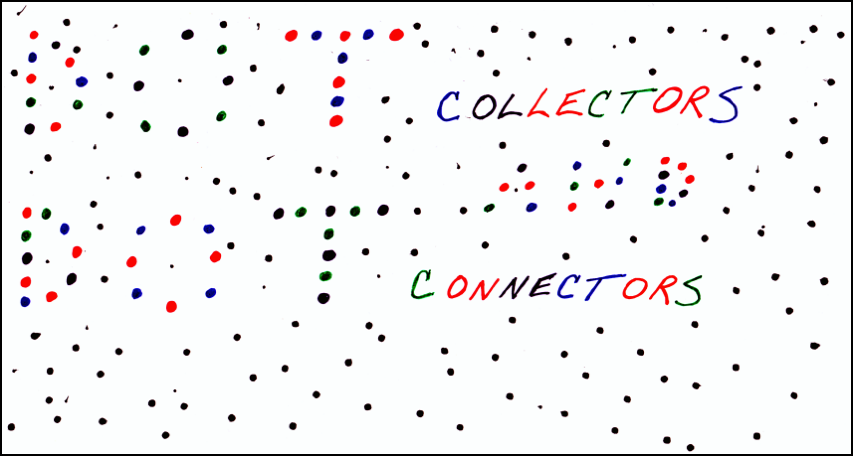
During the podcast, an analogy was made that focusing attention on specific tasks can result in a lot of time spent collecting dots without spending enough time connecting those dots. This point caused me to ponder the division of organizational labor that has historically existed between the dot collection of data management, which focuses on aspects such as data integrity and data quality, and the dot connection of business intelligence, which focuses on aspects such as data analysis and data visualization.
I think most data management professionals are dot collectors since it often seems like they spend a lot of their time, money, and attention on collecting (and profiling, modeling, cleansing, transforming, matching, and otherwise managing) data dots.
But since data’s value comes from data’s usefulness, merely collecting data dots doesn’t mean anything if you cannot connect those dots into meaningful patterns that enable your organization to take action or otherwise support your business activities.
So I think most business intelligence professionals are dot connectors since it often seems like they spend a lot of their time, money, and attention on connecting (and querying, aggregating, reporting, visualizing, and otherwise analyzing) data dots.
However, the attention blindness of data management and business intelligence professionals means that they see selectively, often intentionally selecting to not see the same things. But as more of our personal and professional lives become digitized and pixelated, the big picture of the business world is inundated with the multifaceted challenges of big data, where the fast-moving large volumes of varying data are transforming the way we have to view traditional data management and business intelligence.
We need to replace our perspective of data management and business intelligence as separate monotasking activities with an expansive form of organizational multitasking where the dot collectors and dot connectors work together more collaboratively.
Related Posts
Channeling My Inner Beagle: The Case for Hyperactivity
The Wisdom of the Social Media Crowd
No Datum is an Island of Serendip
The Real Data Value is Business Insight
Information Overload Revisited
Neither the I Nor the T is Magic
OCDQ Radio - Big Data and Big Analytics
OCDQ Radio - So Long 2011, and Thanks for All the . . .