
The Challenging Gift of Social Media
/
I recently finished reading (and also highly recommend) the excellent book Linchpin: Are You Indispensable? by Seth Godin.
Although it’s not the subject of the book, in this blog post I’ll focus on one of its concepts that is very applicable to social media.
The Circles of the Gift System
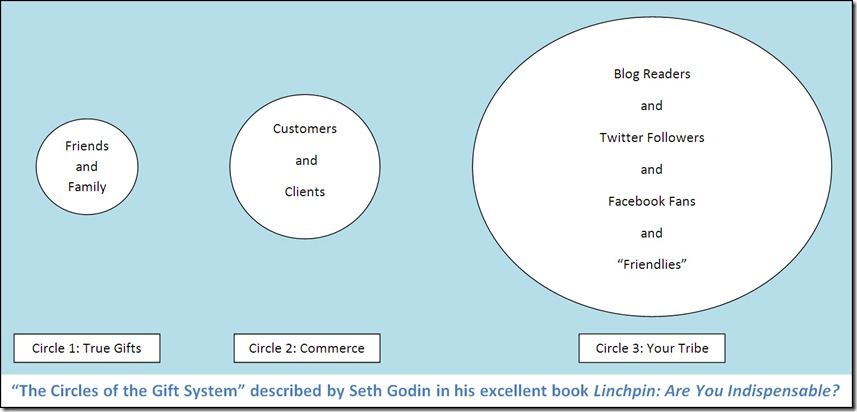
Godin uses the term “Gift Culture” to describe an emerging ethos facilitated by (but not limited to) the Internet and social media, which involves what he calls “The Circles of the Gift System” that I have attempted to represent in the above diagram.
In the first circle are your true real-world friends and family, the people that you would never interact with on the basis of trying to make money (i.e., the people you freely give “true gifts” while expecting nothing in return).
In the second circle are your customers and clients, the people that you conduct commerce with and who must pay you for your time, products, and services (i.e., the people and organizations you don’t give gifts because you need them to help pay your bills).
In the third circle is the social media and extended (nowadays mostly online) community, where following the freemium model, you give freely so that you can reach as many people as possible. It is in the third circle that you assemble your tribe comprised of blog readers, Twitter followers, Facebook fans, and other “friendlies” — the term Godin uses for our social media connections.
It is the third circle that many (if not most) people struggle with and often either resist or ignore. However, as Godin explains:
“This circle is new. It’s huge and it’s important, because it enables you to enlarge the second circle and make more money, and because it enables you to affect more people and improve more lives.”
However, dedicating the necessary time and effort to enlarge the third circle doesn’t guarantee you will enlarge the second circle, which risks turning freemium into simply free. It is on this particular aspect that I will focus the remainder of my blog post.
The Intriguing Opportunity of Social Media
It is difficult to imagine a business topic generating more widespread discussion these days than social media. That’s not to say that it is (or that it even should be) considered the most important topic. However, almost every organization as well as most individual professionals have at the very least considered getting involved with social media in a business context.
The intriguing opportunity of social media is difficult to ignore—even after you ignore most of the hype (which is no easy task).
But as I wrote in the Social Karma series, if we are truly honest, then we all have to admit that we have the same question:
“What’s in this for me?”
Using social media effectively can definitely help promote you, your expertise, your company, and its products and services. The primary reason I started blogging was to demonstrate my expertise and establish my authority with regards to data quality and its related disciplines. As an independent consultant, I am trying to help sell my consulting, speaking, and writing services.
The Sobering Reality of Social Media
A social media strategy focused entirely on your own self-promotion will be easily detected by the online community, and could therefore easily result in doing far more harm than good. Effectively using social media for business requires true participation, sustained engagement, and making meaningful contributions to the community’s goals—and not just your own.
The sobering reality of social media is that it’s not something you can simply do whenever it’s convenient for you.
Using social media effectively, more than anything else, requires a commitment that is mostly measured in time. It requires a long-term investment in the community, and the truth is you must be patient because any returns on this investment will take a long time to materialize.
If you are planning on a quick get in, get out, short-term marketing campaign requiring little effort, then don’t waste your time, but much more importantly, don’t waste the community’s time.
The Challenging Gift of Social Media
Godin opens his chapter on “The Powerful Culture of Gifts” by joking that he must have been absent the day they taught the power of unreciprocated gifts at Stanford business school.
In fact, it’s probably a safe bet that the curriculum at most business schools conveniently ignores the fifty thousand year tradition of human tribal economies based on mutual support and generosity, when power used to be about giving, not getting.
Although we maintain some semblance of this tribal spirit in our personal lives with respect to the first circle, when it comes to our professional lives in the second circle, we want money for our time, product, or service—and we usually don’t come cheap.
Therefore, by far the most common question that I get asked (and that I often ask myself) about social media is:
“Is it really worth all that time and effort, especially when you aren’t getting paid for it?”
Although I honestly believe that it is, truthfully there have been many times when I have doubted it. But those were usually times when I allowed myself to give in to the natural tendency we all have to become hyper-focused on our own goals.
The paradox is that the best way to accomplish our selfish goals is—first and foremost—to focus on helping others.
Of course, helping others doesn’t guarantee they’ll reciprocate, especially with financial returns on our social media investment. Returning to Godin’s analogy, enlarging (or even just maintaining) the third circle doesn’t guarantee enlarging the second circle.
However, true service to the social media community requires giving true gifts to the third circle.
Godin explains that these gifts—which do not demand reciprocation—turn the third circle into your tribe. Giving gifts fulfills your tribal obligation. Recipients pay it forward by also giving gifts—but perhaps to another tribal member—and not back to you.
And this is the challenging gift of social media—it is a gift that you may keep on giving without ever getting anything in return.
Related Posts
Freemium is the future – and the future is now